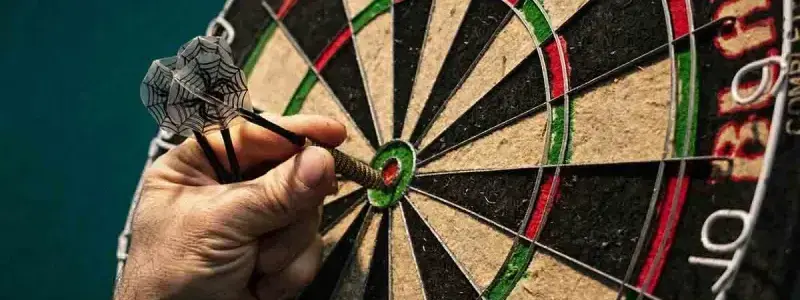
The Dartboard's Numbers Are Rigged on Purpose
You go for the treble 20 one more time, and the dart drifts a centimeter left into the fat single 1. That sting isn't bad luck — the board was numbered on purpose to punish exactly that kind of greed.
The Design Punishes Inaccuracy
The numbering system most boards use today is credited to Brian Gamlin, a carpenter who worked it out in 1896. His idea was simple: put big numbers next to small ones so a near-miss costs you dearly.
Look at the top of the board and you'll see it in action. The 20 sits between the 1 and the 5, so aiming high-risk and missing drops your score from a possible 60 to as little as 1.
The 19 gets the same treatment, flanked by the 3 and the 7. Every tempting target on the board has cheap real estate right beside it, which is why some players deliberately switch to the 19 when their 20s go cold.
Why That Matters in 501
In the standard game of 501, you start with 501 points and subtract what you score each turn. You have to land on exactly zero, and your final dart must hit a double or the bullseye — the full details are in our guide to the rules of 501.
Because you can't afford wasted darts, the board's layout turns every throw into a risk calculation. Chase the treble 20 with a shaky arm and the 1 and 5 will bleed your turn dry.
Go below zero, or land on exactly 1, and the turn is a "bust". Your score resets to where it stood at the start of that turn, so the punishing layout can cost you twice.
How the Scoring Rings Work
Each of the 20 wedges is worth its face value, but the two thin rings change everything. The outer ring doubles the wedge's number, and the inner ring trebles it.
The center has two targets of its own. The green outer bullseye scores 25, and the red inner bullseye scores 50.
That's why the treble 20 — worth 60 — beats the bullseye as the highest-value spot on the board. It's also why the numbering matters: the richest target sits in the riskiest neighborhood.
Where the Board Itself Came From
Darts goes back to the Middle Ages in England, where soldiers threw projectiles at targets to pass the time. The game evolved from there, but the board's shape and numbers settled much later.

- Tournament-spec construction delivers consistent, match-ready performance for players of all skill levels
- Self-healing sisal and a repositionable number ring help extend the board's playing life
- Ultra-thin wiring reduces bounce-outs so more darts land cleanly in the scoring area
A standard board measures 17.75 inches across and is split into 20 radial sections divided by thin metal wire. The double and treble rings are each just 8mm wide, which is why hitting them consistently takes real skill.
Using the Layout to Your Advantage
If your grouping is tight, keep hammering the 20 — the layout only punishes players who miss. If you're spraying darts, aim at the 19 or even the 14, where the neighbors are more forgiving.
Consistency beats bravado either way. A repeatable stance, grip, and release matter more than target choice, and our guide on throwing darts accurately covers how to build that routine.
Know your own accuracy honestly, and let Gamlin's layout work for you instead of against you.