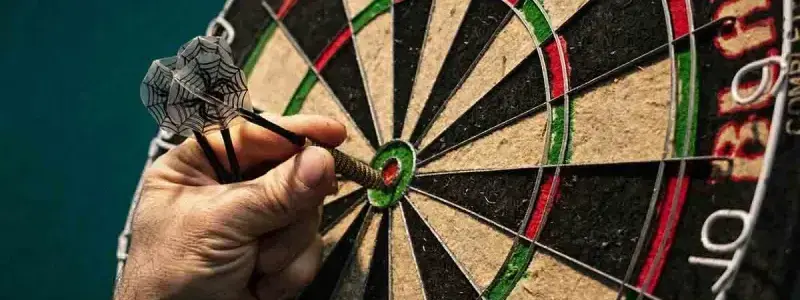
High Ton: The Call That Turns Heads
"One hundred and fifty-seven!" The caller drags out every syllable while the crowd roars, because that one visit just flipped the whole leg.
That shout has a name. In darts, any three-dart turn scoring 151 or more is called a high ton.
What Counts as a High Ton
A high ton is any score from 151 to 180 in a single visit — that's one turn of three darts. Hit 151, 160, or 177, and you've thrown a high ton.
"Ton" is old British slang for 100, borrowed from money and motoring long before it reached the oche. Score exactly 100 and you've hit a ton; everything above it splits into low and high territory.
High Ton vs. Low Ton
A turn of 100 to 150 is a low ton, and 151 to 180 is a high ton. The dividing line is 150 — the best you can do without landing all three darts in the treble bed of a high number.
Both terms describe one visit, never a running total. Your score across the whole leg doesn't matter; only what those three darts add up to.
Where the 180 Fits In
The maximum of 180 — three treble 20s — technically counts as a high ton. But nobody calls it that.
Players and commentators call it a "maximum" or simply a "one-eighty," and it gets its own roar from the crowd. Think of the 180 as the high ton that outgrew the label.
How to Score One
There's no way to reach 151 without trebles — even three bullseyes only make 150. Apart from one odd route (treble 20 plus two bullseyes for 160), every high ton needs at least two darts in the big trebles: 20, 19, or 18.
Common routes include two treble 20s and a treble 17 for 171, or three treble 19s for the same score. That math is why pros camp on treble 20, and if your darts keep drifting out of the treble bed, work on throwing more accurately before chasing big scores.
Why High Tons Matter
In a race to zero, every high ton buys you roughly a full turn on your opponent. Throw a 160 while they score 60, and you've opened a 100-point gap in one exchange.
High tons also set up early checkouts, which is how nine-dart legs happen. That's why 501 scoring rewards heavy scoring first and finishing second.
Marking It on the Board
Chalkers and electronic boards often flag big visits. On a written scoreboard, you'll sometimes see a circled score or "HT" beside a high ton, while league stat sheets track high tons as a season statistic.
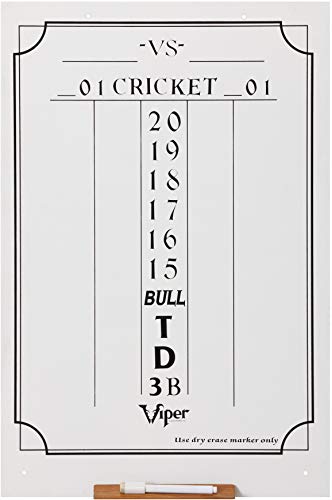
- Purpose-made layout tracks Cricket and 01 games at a glance
- Smooth surface works with any dry erase marker, and one comes included
- Mounting hardware is included for easy setup on a wall or cabinet door
In many pub leagues, high tons earn a mention in the match report — bragging rights, formalized.
Related Terms Worth Knowing
Checkout — the final score a player needs to win, usually finished on a double or the bullseye.
Bust — scoring more than you need to reach zero. The whole turn is wiped, and you start your next visit on the same score.
Nine-darter — a perfect leg of 501 in just nine throws, the fewest possible. It takes back-to-back maximums to even have a chance.
Commentary is full of the rest — madhouse for double 1, bed and breakfast for 26 — and the darts glossary defines each one with an example.
Next time you break 150 in a visit, call it out — you've earned the name.