What Green Really Means on a Dartboard
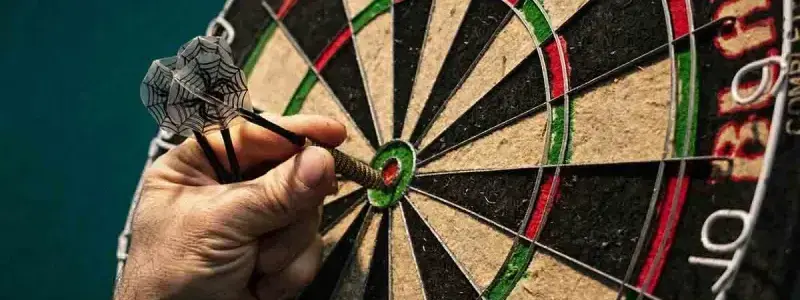
Your dart drifts a hair high of the red bullseye and buries itself in the green ring wrapped around it. That miss just scored 25 points — welcome to the outer bull.
Green sits at the very center of every standard dartboard, and it confuses more new players than any other color. Here's what it means — and when it doesn't mean what you think.
The Green Ring at the Center
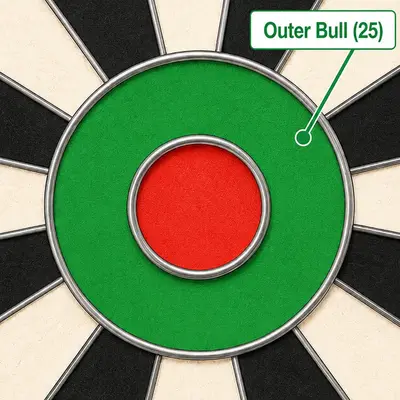
The green circle around the board's red center is the outer bull, also called the "25" or the single bull. Land a dart anywhere in it and you score exactly 25 points.
The smaller red circle it surrounds is the inner bull — better known as the bullseye. That one's worth 50.
Green Doesn't Always Mean 25
Here's the catch: green also shows up in parts of the double and treble rings. In those areas the color tells you nothing about the score — the number beside the section does.
A green double scores twice the section's number, and a green treble scores three times it. Treble 19 pays 57 points and double 16 pays 32 — same color, completely different scores.
The treble, which some players call the triple, is that thin inner ring and one of the most valuable areas on the board. Treble 18 alone scores 54.
The Five Scoring Areas
A standard dartboard breaks down into five scoring zones:
- The large single-scoring areas, worth the number beside the section
- The outer double ring, worth twice that number
- The inner treble ring, worth three times that number
- The green outer bull, worth 25
- The red inner bull, worth 50
Once those five click, dartboard scoring stops feeling mysterious. Color helps you spot the zones — the numbers do the actual math.

- Regulation compressed sisal surface heals around steel tips for a long playing life
- Rotating number ring spreads out wear to extend the board's lifespan
- Includes six steel tip darts so you can start playing right out of the box
What About the Black Sections?
There's no fixed score for a black segment either. A dart in the big black single area of the 20 scores 20 points, while the same landing spot in the 5 section scores 5.
The board's 20 numbered sections also sit in a deliberately awkward order, with high numbers beside low ones — the 20 lives between the 1 and the 5. A slightly loose throw gets expensive fast, and that layout is no accident.
Each numbered section contains two single areas, one double, and one treble. The two bulls sit at the center of it all.
Outer Bull vs. Bullseye
Because it scores 25, the outer bull is commonly called the single bull — and the red center the double bull, since its 50 points are worth exactly twice as much. Plenty of players just say "outer bull" and "bullseye."
For all its fame, though, the bullseye isn't the board's top prize. Its 50 points trail the 60 available from treble 20 — the biggest one-dart score there is, and the reason skilled players aim at it so often.
When Nothing Counts
A dart that lands outside the outer double ring scores zero. That wire marks the edge of the scoring area, and anything beyond it is a miss even if the dart sticks in the board.
One more rule: the dart has to stay in the board until the score's recorded. If it falls out before it's counted, it normally scores nothing.
Next time you step to the oche, read the number before you trust the color.