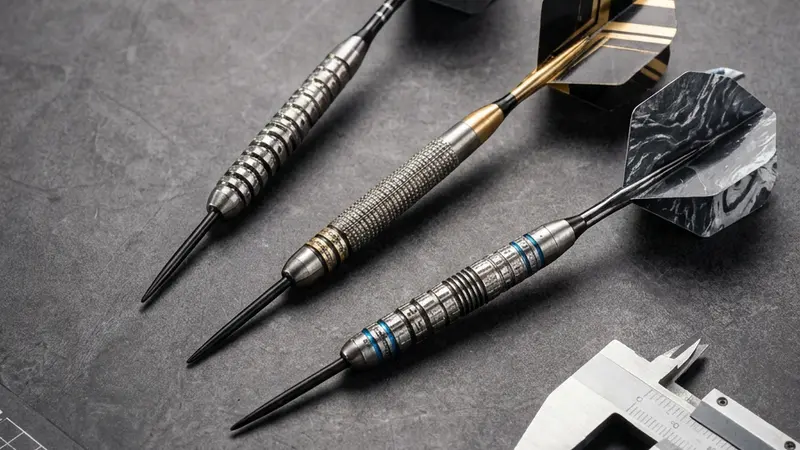
What Darts the Pros Throw: The Real Specs
The walk-on music cuts out, the crowd goes quiet, and under the TV lights a world champion rolls three slim tungsten darts between his fingers like he's thrown them ten thousand nights in a row. He has — and every detail of those darts, from weight to flight shape, was chosen for a reason you can steal.
Steel tip is the pro standard
Watch any major televised tournament and you'll see steel-tip darts hitting a traditional sisal board. Soft-tip darts exist on the pro scene too, but they're built for electronic boards and a different circuit.
If you're aiming to play the way the pros on TV do, steel tip is the format to learn. It's also what every classic pub board is made for.
Why pros throw tungsten
Nearly every professional throws darts made from a high-percentage tungsten alloy, typically somewhere between 80% and 95% tungsten. Brass and nickel-silver darts still exist, but you won't find them on a pro stage.
The reason is density. Tungsten packs the same weight into a much slimmer barrel, so three darts can land tight together in the treble 20 without blocking each other out.
Slimmer darts mean tighter groupings, and tighter groupings mean bigger scores. That's the whole argument, and it's why tungsten won.
The weights pros favor
Professional steel-tip darts generally run from 18 to 26 grams, with most players settling in the low-to-mid 20s. There's no single "correct" weight — champions have won world titles at both ends of that range.
Heavier darts tend to fly on a flatter, more forgiving path, which suits players with a relaxed throw. Lighter darts demand a quicker, cleaner release but feel effortless in the hand.
If you want the full breakdown of how weight changes a throw, see what dart weight the pros use.
Signature setups: the parts that matter
Most touring pros throw a signature dart built to their exact spec — barrel shape, grip pattern, shaft, and flight all locked in. The spec itself matters less than the fact that it never changes, because consistency is what a repeatable throw is built on.
Shafts come in nylon, aluminum, and carbon fiber. Nylon is cheap and absorbs deflections, aluminum is stiff and durable, and carbon fiber offers the stiffness without the weight.
Flights come in standard, slim, and kite shapes. Most professionals stick with standard flights because they stabilize the dart through a wide range of throwing styles.
What this means for your darts
Copying a pro's exact setup won't give you their throw, but their logic transfers perfectly. Start with a 90% tungsten steel-tip dart in the 22–24 gram range, standard flights, medium shafts.
Then adjust one variable at a time until the dart disappears into your throw. If you're still deciding on a starting point, our guide to what kind of darts you should buy walks through it step by step.

- Front-weighted barrels support a comfortable and controlled three-point grip
- Deep grooves and triple-milled surfaces provide a secure grip for more consistent throws
- The included storage box keeps up to 12 darts and spare parts organized and protected
Related questions
Why is tungsten preferred for professional darts?
Tungsten's density allows a much slimmer dart at the same weight. Slimmer barrels let pros stack three darts in one bed without crowding it.
Are heavier darts better than lighter ones?
Neither is better — it comes down to your release. Some players control heavier darts more easily, while others score better with a lighter, faster throw.
What are the different types of dart flights?
The common shapes are standard, slim, and kite. Standard flights suit most players, while slim and kite flights help hard throwers and lighter darts respectively.
Are there rules about dart materials in professional play?
No — brass, nickel-silver, and tungsten are all legal in professional competition. Tungsten dominates purely because it performs better, not because the rules require it.
Do professionals use soft-tip or steel-tip darts?
The major televised tours are played with steel-tip darts on sisal boards. Soft tips belong to the electronic-board circuit, and our guide to the best steel-tip darts covers the pro-style option.
Pick one spec, throw it for a month, and only then change a single thing.