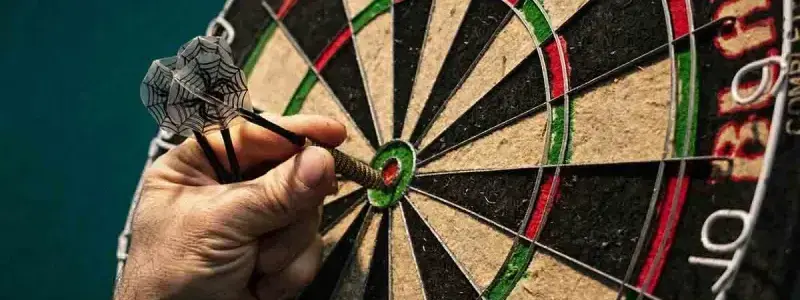
Pro Dart Weights: Copy Them at Your Peril
The camera tightens on the world champion as he pulls three darts out of the treble 20, and you catch yourself squinting at the barrels, wondering what they weigh. Here's the catch: copying that number probably won't fix your game.
There's no secret "pro weight." Most professionals throw somewhere between 21 and 24 grams, and the spread exists because the weight has to fit the thrower — not the other way around.
The Short Answer: 22 to 23 Grams
The most common weights on the professional circuit are 22 and 23 grams. That range gives most players a workable balance of control, speed, and stability.
A 23-gram dart sits right in the middle. It feels solid in the hand without slowing the throw down.
The full spread is wider than you'd think, though. Some pros compete with darts around 18 or 20 grams, while others throw 24 grams or more.
Why Pros Don't All Throw the Same Weight
Every throwing action is different. A fast, snappy throw usually pairs better with a lighter dart, while a slow, smooth action can carry a heavier one.
Grip changes the equation too. A player who holds the dart near the front wants a different balance than someone gripping the back of the barrel.
Even release timing matters. A single gram can change how the dart leaves your fingers and the angle it takes into the board.
Heavier vs. Lighter: What Actually Changes
| Heavier darts | Lighter darts | |
|---|---|---|
| Feel in the hand | Stable and solid through the throw | Quick and responsive |
| Effort needed | Less — the weight carries the dart | More — you supply the pace |
| Small errors | Hidden a little longer | Show up farther from the target |
| Main risk | Late release, arm fatigue in long sessions | Grip or release slips get magnified |
Heavier darts don't automatically fly straighter, though. Technique still beats the number stamped on the barrel.
Lighter darts reward players with quick hands and a strong, confident throw. They feel easy to adjust, but they punish a sloppy release.
Why Almost Every Pro Throws Tungsten
Most professionals use tungsten darts because tungsten is dense. A dense barrel stays slim while still carrying full weight.
Slim barrels matter when you're stacking three darts in the same bed. There's simply more room left in the treble 20 when each dart takes up less of it.
The tungsten percentage isn't the whole story, though. Barrel shape, grip pattern, shaft length, and flight size all change how a dart feels.
Should You Copy a Pro's Setup?
Pros win because their equipment matches their technique, and because they've thrown it until the motion is automatic. The weight is a consequence of their throw, not the cause of their titles.
By all means browse what darts the professionals use for ideas. Just treat their specs as a menu, not a prescription.
How to Find Your Own Best Weight
Most beginners do well starting with steel-tip darts between 22 and 24 grams. A 23-gram set is the sensible first buy.

- Front-weighted barrels support a comfortable and controlled three-point grip
- Deep grooves and triple-milled surfaces provide a secure grip for more consistent throws
- The included storage box keeps up to 12 darts and spare parts organized and protected
From there, test one lighter and one heavier set. Give each one several full practice sessions — a handful of throws tells you nothing.
Judge by grouping, not scoring. Three darts landing tight together beats one lucky treble 20 every time.
Weight affects rhythm, release, and how the dart sits in the board, but it can't fix a rushed throw or a wobbly stance. If you want a step-by-step method, we've covered how to choose your dart weight in detail.
Pick one weight, throw it for two weeks, and let your groupings — not the pros — make the final call.