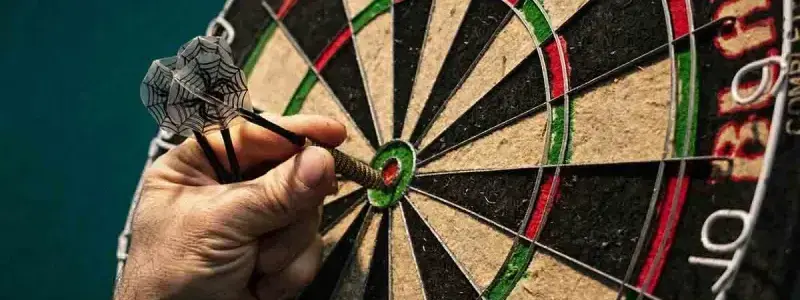
American Darts: The Official Rules, Settled
A chalker taps the board in a corner tavern and calls it: "Diddle — closest to the bull throws first." Two long wooden darts arc in, and a game of American darts is under way.
American darts is a homegrown variant played across many parts of the United States. It swaps the familiar bristle board for basswood, standard darts for wooden ones, and the race-to-zero format for innings.
What Makes American Darts Different
The board is made of basswood, and the darts — called "widdies" — are wooden and unique to this game. Both give American darts a feel all its own.
The board itself has a distinct layout and history worth knowing. Our overview of American darts boards covers where the game comes from and what you'll play it on.
The Diddle: Deciding Who Throws First
Every game opens with a diddle. Both players throw one dart at the bullseye, and the player whose dart lands closer starts the game.
From that point on, the throwing order is fixed. All players must respect the predetermined order for the rest of the game.
The Official Rules
- Each game is divided into innings, and each inning is assigned a number — the 1st inning uses the 1, the 2nd inning the 2, and so on.
- The targets run from 1 through 9, then finish on the bullseye, for ten innings in total.
- In each inning, players try to hit the number that matches that inning.
- A dart in a triple counts as three hits, and a dart in a double counts as two.
- A throw made before the inning's number is announced is invalid.
- The player with the most points after the tenth inning wins.
Quick Reference
| Setup | Detail |
|---|---|
| Board | Basswood |
| Darts | Wooden widdies, typically 12–15 grams |
| Board height | 5 ft 3 in from floor to bullseye center |
| Game length | 10 innings — the 1 through the 9, then the bullseye |
| First throw | Winner of the diddle |
| Winner | Most points after the tenth inning |
When a Dart Counts
A dart that bounces off or falls off the board is a miss and scores nothing. There's one exception: if the dart sticks long enough to be scored and falls afterward, the score stands.
If the innings rhythm feels familiar, it should. It's the same structure that drives baseball darts on a standard board.
Ties and Extra Innings
If the score is level after ten innings, the game moves to extra innings, replaying the same sequence of targets until someone pulls ahead. Still tied after that?
Sudden-death rounds settle it. A drawn game is technically possible, but in practice it's very rare.
The Widdies
Widdies are longer than standard darts but noticeably lighter. They typically weigh around 12 to 15 grams, compared with the 18 to 26 grams of a common steel-tip dart.
That light weight changes the throw. Expect a few wobbly innings before the widdies start to obey.
Hanging the Board
An American darts board hangs with the center of the bullseye 5 feet 3 inches off the floor. That's not the same as a standard steel-tip setup, so check our guide to dartboard height and distance before you drill twice.

- A full inch of cork absorbs missed throws, protecting both walls and dart points
- Self-healing surface closes up after impacts and stays clean-looking over time
- Cuts easily to size and mounts vertically or horizontally around any board
Find a basswood board, diddle for the bull, and let the first inning begin.