
Scoring Darts: Learn It Before They Notice
Three darts in the board, and three different answers at the chalkboard. Scoring disputes end more pub games than bad throws ever do — so here's how dart scoring actually works.
Hitting the board is only half the job. You've also got to know what each section pays and how to run the numbers.
Scoring Basics
You score points whenever your dart sticks in the board. The board is divided into numbered segments, and the number on a segment is what a dart there earns.
Miss the board entirely and you get zero. What you do with the points depends on the game — the most popular modes, and the ones used competitively, are 501 and 301.
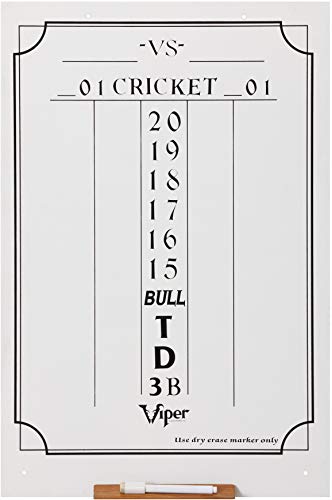
- Purpose-made layout tracks Cricket and 01 games at a glance
- Smooth surface works with any dry erase marker, and one comes included
- Mounting hardware is included for easy setup on a wall or cabinet door
Singles, Doubles, and Trebles
Where the dart lands inside a segment matters as much as the number. Each segment has three scoring areas.
The large single area pays exactly the number shown. Hit the 10 there and you score 10.
The thin outer ring — traditionally painted red or green — is the double ring. A dart in the double 10 pays 20.
The thin inner ring, halfway to the center, is the triple (or treble) ring. Land there and the number is tripled.
That's where strategy creeps in. Trebles pile up points fast, but new players often do better camping on fat singles while their aim sharpens up.
The Bullseye
The bullseye is really two targets in one. The outer ring of the bull scores 25 points.
The inner circle scores 50. Most games pay it that way, though some game modes value the bull differently.
When a Dart Counts
The wires that divide the board's sections are called spiders. Hit one and your dart usually bounces off — and a bounced dart scores nothing in competitive play, though some pubs let you keep the points.
On a traditional board, any bounce-out goes unscored. There's simply no way to prove where the dart landed. Beginners expect a re-throw and never get one — that dead dart is one of the rules beginners get wrong most often.
Electronic boards work differently. Soft-tip darts press into small holes and sensors record the exact segment at impact, so many electronic dartboards count a dart even if it bounces out afterward.
One more quirk: a dart propped up by the darts beside it still counts. As long as it doesn't fall and stays touching the board, it scores where it sits.
Doing the Math
Every darts night is quiet arithmetic. Singles just add up: hit 5, 10, and 4, and your visit is worth 19.
In 501, you then subtract that from your total. Score 19 on your first turn and you're standing on 482.
Doubles and trebles multiply before you add. Say you hit double 10, single 2, and treble 9 — that's 20 + 2 + 27 for a 49 visit, taking 501 down to 452.
It sounds odd at first, but in the classic games you subtract far more than you add. The running total falls, turn by turn, toward zero.
Scoring Other Games
Not every game runs on subtraction. Two favorites score in completely different ways.
Cricket
In Cricket, only 15 through 20 and the bullseye count. You "close" a number with three hits — a single counts as one hit, a double as two, a treble as three.
Once you've closed a number your opponent hasn't, extra hits on it score at face value. Close everything with the higher total and you win; the full ruleset lives in our guide to Cricket darts.
Killer
Killer starts with each player throwing one dart with their non-dominant hand — the number it hits becomes theirs for the night. Hit your own number and you become a "killer."
From there you hunt opponents' numbers to strip their lives. It's a game of pure precision, with barely any adding or subtracting at all.
How to Score Dart Games (Video)
Grab chalk or a scoring app, run the math out loud for a few legs, and it'll be second nature before the night's over.