
Halve It: Miss Once, Lose Half Your Score
Ninety-eight points and a comfortable lead, then three straight darts miss the 17 completely. The scorer grins, scrubs out your total, and writes 49.
That's Halve It in one round: build a score all night, lose half of it in seconds. Here's how the game works, how to score it, and how to keep your lead out of the shredder.
What Is Halve It?
Halve It is a classic darts game where every round assigns a different target. Hit it and you add points; miss with all three darts and your entire score gets cut in half.
That brutal penalty gives the game its name — and its charm. No lead is safe until the final dart lands.
Unlike games that let you camp on your favorite number, Halve It drags you all over the board. One round wants a specific segment, the next wants any double, and the bullseye shows up just when you're getting comfortable.
Setting Up
Pick a list of targets and agree on their order before anyone throws. Targets can be numbered segments, doubles, triples, bullseyes, or anything else the group accepts.
A simple target list looks like this:
- 16
- 17
- Any double
- 18
- Any triple
- 19
- Bullseye
Players can start at zero or from an agreed score. Points on the board from the start make the halving penalty dangerous in round one, while starting at zero eases everyone in.
Decide up front how to halve odd scores — round down or allow half-points. Rounding down is simpler for casual play.
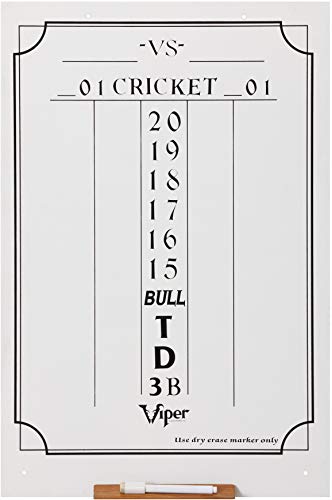
- Purpose-made layout tracks Cricket and 01 games at a glance
- Smooth surface works with any dry erase marker, and one comes included
- Mounting hardware is included for easy setup on a wall or cabinet door
Rules and Scoring
Each player throws three darts per round, and only darts that hit that round's target score. Everything else is a miss, however pretty it looks.
Hit the target at least once and you add the value of every successful dart to your total. Miss with all three and your score is halved on the spot.
The player with the highest total after the final target wins.
Some groups use a house rule where a player on zero drops to minus one after a miss, then doubles that negative score after successful hits. It's not standard Halve It, so only play it when everyone understands exactly how it works.
A Worked Example Turn
Say the round's target is 18. A single 18 scores 18 points, a double 18 scores 36, and a triple 18 scores 54.
You land a single 18, a triple 18, and a stray dart in the 4. The 4 counts for nothing, so you add 18 plus 54 — 72 points — to your total.
In an "any double" round, only darts in the double ring count. The same idea applies to triple and bullseye rounds.
Strategy: Protecting Your Score
Practice the whole board
A player who only feels at home on one number looks strangely helpless in Halve It. Work on awkward segments, doubles, triples, and both bullseye rings — doubles practice drills help more here than anywhere.
You're not chasing perfection. You just want fewer targets that make your stomach drop when they come up.
Take the safe points
A flashy triple is tempting when people are watching. But the large single section is often the smarter target when a miss would slice a strong score in half.
Halve It rewards survival as much as ambition. Sometimes the least glamorous throw wins the game.
Forget the first bad dart
One missed throw can trigger panic and two more ugly misses. Step back, reset your stance, and treat the next dart as a fresh attempt.
You still have two chances to dodge the penalty. Don't let one bad throw become a full public collapse.
Read the scoreboard
With a big lead, safer throws protect it; trailing badly, you may need doubles or triples to close the gap. Just remember that desperation and accuracy rarely make a happy couple.
Making It Fit Your Group
Beginners enjoy larger numbered targets and forgiving rounds like "any double." Experienced players can make it nastier with exact doubles, exact triples, or specific bullseye sections. If you'd rather borrow a ready-made list, Bermuda Triangle darts runs the same halving rule through a fixed 13-round sequence that ends on the double bull.
A good target list creates suspense, not misery. It's one of the best darts games for groups because you can tune it to any skill mix.
Before the first dart, confirm the starting score, target order, odd-total rule, bounce-outs, and whether the outer and inner bull count separately. Clear rules prevent arguments when somebody's beautiful lead gets cut in half.
Halve It also doubles as sneaky practice, forcing you to aim everywhere instead of hiding in favorite scoring areas. If you like games that tour the board, Around the World makes a good warm-up for it.
Chalk up a target list tonight and find out how steady your nerves really are.