
How to Play Darts: Start Here, Thank Us Later
Three darts. One board. A line on the floor. That’s the whole game — and it’s exactly why darts is so easy to start and so hard to put down. What began as a friendly pub contest grew into a recognized sport, with the British Darts Organization (BDO) formalizing the rules that players still follow today.
If you’re picking up darts for the first time, this guide covers everything you need: the board, the setup, and the games worth learning first.
Use The Right Board
The standard dartboard is the clock board, also called the trebles board. It’s divided into 20 numbered wedges pointing toward the center, with the numbers 1 through 20 arranged in a deliberately scrambled order — so a wild miss on 20 can land you in 1 or 5.
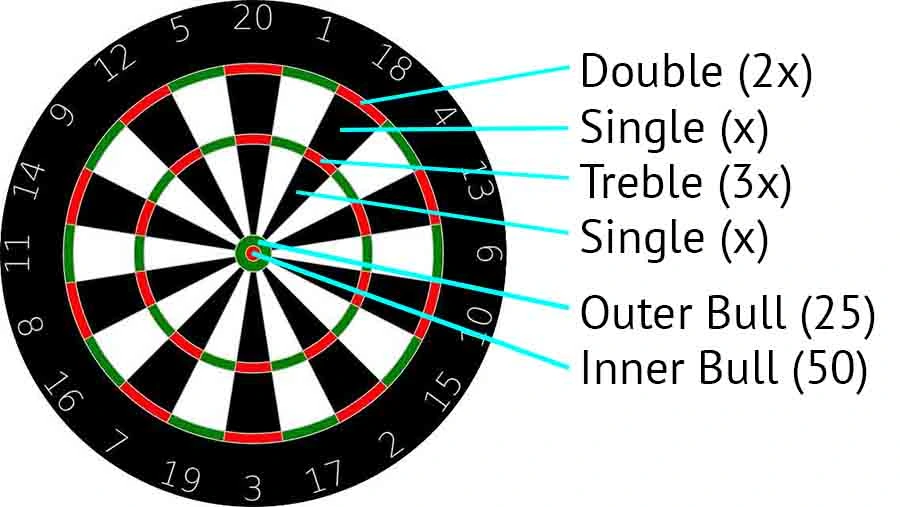
Four zones on the board matter for scoring:
The center of the board holds two circles. The small ring around the middle is the outer bull, worth 25 points. The dot inside it is the inner bull — the bullseye — worth 50.
Two thin rings multiply your score. The treble ring, halfway out from the center, triples the wedge’s number. The double ring, at the outer edge, doubles it. Land a dart in the treble 20 and you’ve scored 60 — the highest single throw in the game.
Quality boards are made of sisal, a plant fiber similar to hemp. It’s self-healing: pull a dart out, and the hole closes behind it.

- Complete ready-to-play setup with bristle board, cabinet, two dart sets, oche line, and scoreboard
- Cabinet protects the surrounding wall and closes the board away neatly after play
- Quality sisal board suits everyone from first-timers to league players
Darts
Ask ten players what the right dart is and you’ll get ten strong opinions. As a beginner, you only need the basics.
Your darts should be front-weighted, a few inches long, sharp at the tip, and flighted — the fins at the back that keep them flying straight. You’ll need three.
Placement of the Board
Official rules are strict about setup. The bullseye should sit five feet eight inches above the floor.
Players throw from behind a line called the oche — a raised block one and a half inches high in formal play, though a strip of tape works fine at home.
The oche sits seven feet nine and a quarter inches from the board, measured from the front of the oche to the face of the dartboard.
Rules: Which Version to Play
The two most popular games are 501 and 301. Competitive players almost always choose 501, so start there.
Game: 501
Every player starts with 501 points. On your turn, you throw three darts, and everything you score is subtracted from your total. The inner bull is worth 50, the outer bull 25, and the treble and double rings multiply the wedge you hit.
Land in the double ring on the 10 wedge? That’s 20 points off your score.
The goal is to reach exactly zero — and here’s where the game gets tense. Your final dart must land in the double ring (or the inner bull, which counts as double 25). This is called “doubling out.” With 32 left, the winning throw is double 16.
Miss the finish and you go “bust”: dropping below zero, leaving exactly 1 (no double can score 1), or hitting zero without ending on a double. Your turn ends immediately and your score resets to where it stood at the start of that turn.
You don’t need all three darts to finish. If your first dart of the turn lands the winning double, the game is over.
Rule Adjustment: Splitting the 11
Some players add a lifeline for when your score sits at 1. Instead of going bust, you can aim for the gap between the two digits of the number 11 printed at the edge of the board. Thread that needle and you win. It’s a very hard shot — which is exactly what makes it fun.
Game: 301
301 works exactly like 501, but you start with 301 points. It’s the better choice when you want a quicker game.
Alternative Dart Game: Around the Clock
Around the Clock is the best practice game in darts — and a fun one in its own right.
The goal: hit every number in order, 1 through 20, then the outer bull, then the bullseye. You can’t move on until you’ve landed a dart in your current number. You get three darts per turn, and the first player to hit the bullseye wins.
Because it forces you to aim at every part of the board, it sharpens your accuracy faster than any other game.
Alternative Dart Game: Killer
Got a big group? Play Killer darts.
To start, each player throws one dart with their non-dominant hand — righties throw lefty, and vice versa. Whatever wedge it lands in becomes that player’s number. Everyone starts with five lives.
Now aim for your own number. Hit it (in many versions, its double) and you become a killer. Killers hunt everyone else: each dart you land on an opponent’s number costs them a life.
Lose all five lives and you’re out. The last player standing wins the pot.
How to Play Darts (Video)
Related Questions
- What is the standard dartboard like, and how is it used for scoring in a game of darts?
The standard board (the trebles board) has 20 wedges numbered 1–20 in a scrambled order. The outer bull scores 25 and the inner bull 50. The treble ring triples a wedge’s number, and the double ring at the edge doubles it.
What are the specific regulations related to the placement of the dartboard, and where should the player stand?
The bullseye sits five feet eight inches above the floor. Players throw from behind the oche, a line seven feet nine and a quarter inches from the face of the board.
How do you play the 501 and 301 versions of darts?
Both games count down from a starting score — 501 or 301 — with each throw subtracted from your total. The winner is the first to reach exactly zero, finishing on a double.
Can you explain the Around the Clock game mode in darts?
Players race to hit every number in order from 1 to 20, then the outer bull, then the bullseye. You can’t advance until you hit your current number, and the first player to finish on the bullseye wins.
What is the typical material used for dartboards, and why?
Quality dartboards are made of sisal fiber, a plant fiber similar to hemp. Sisal is self-healing — holes close up after darts are removed — so the board lasts through thousands of throws.
What are the basic characteristics of the darts used in the game?
Darts are front-weighted, a few inches long, and sharp-tipped, with flights (fins) at the back for stable flight. Each player throws three per turn.
What is the “splitting the 11” rule in darts?
When a player’s score is 1 — normally a bust situation — this optional rule lets them win by throwing a dart between the two digits of the 11 at the board’s edge. It’s a difficult shot that adds drama to the endgame.