Cricket Darts: The Rules, Minus the Arguing
Two marks sit under the 20 on the chalkboard, and your opponent needs one more hit to lock you out of the board's biggest number. Your next dart decides who owns it for the rest of the game.
That tug-of-war over numbers is Cricket, the most popular darts game in American bars. The rules confuse plenty of first-timers, so here's the whole game, step by step.
What Is Cricket?
Cricket is a race to "close" a small set of targets — the numbers 15 through 20 plus the bullseye — while piling up points on the ones you own. Darts in any other number count for nothing.
Each player or team throws three darts per turn. The skill isn't just accuracy; it's choosing which number to attack at the right moment.
Closing Numbers
You close a number by hitting it three times. The double ring counts as two hits, and the treble counts as three — one treble closes a number instantly.
Once you've hit a number for the third time, it's closed for your side. It stays live for scoring, though, until the other team closes it too.
Scoring Points
Points come from numbers you've closed but your opponents haven't. Every extra hit on such a number adds its face value to your total, and you can keep hammering it turn after turn.
The moment the other team closes that number, the tap shuts off. No more points are available there for anyone.
The game ends when both sides have closed everything from 15 to 20 plus the bull. Highest point total wins. Longer variants stretch that target list — Mickey Mouse darts runs 20 down to 12 and adds separate lines for doubles, triples, and bulls.
A Worked Example Turn
Say you've closed 20 and your opponent hasn't. Your first dart lands in the single 20, banking 20 points.
Your second dart hits treble 19 — three hits at once — closing 19 on the spot. A final single 20 makes it 40 points for the turn plus a freshly closed number.
Keeping Score and Breaking Ties
Cricket scoring is hard to hold in your head, so keep a chalkboard or notepad by the oche. Track each side's closed numbers, their running points, and which numbers are still open for scoring.
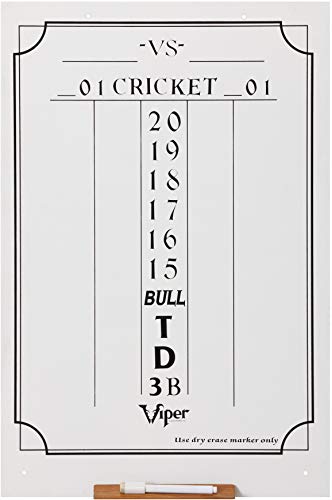
- Purpose-made layout tracks Cricket and 01 games at a glance
- Smooth surface works with any dry erase marker, and one comes included
- Mounting hardware is included for easy setup on a wall or cabinet door
Note when each number gets closed, too. If the game ends level on points — or nobody scored at all — the tie goes to the side that closed out all its numbers first.
Once the marks-and-points rhythm clicks, the real game becomes shot selection. Our Cricket strategy guide digs into when to score, when to close, and when to block.
English Cricket: The Pub Variation
English pubs play a different Cricket, modeled on the bat-and-ball sport. One player bats while the other bowls, and the batter goes first.
Ten stripes — the wickets — go up on the scoreboard. The bowler knocks one off with every bullseye, and a double bull removes two.
The batter scores freely on the whole board while wickets remain, but only points beyond a 40-point threshold count. Score 60 in an innings and you record 20.
When the wickets are gone, the players swap roles and play a second innings the same way. Most points after both innings wins — the full rules live in our English Cricket guide.
Both versions sharpen your accuracy fast, and Cricket's blocking battles teach shot selection like nothing else. If you enjoy that scrap for numbers, Scram darts is a natural next game to learn.
The Game of Cricket (Video)
Chalk up 15 through bull tonight, and fight for the 20s first.