Belgian Darts: The Café Game Time Forgot
Seven points left, and the café table goes quiet as you line up a feather-fletched dart at a board barely bigger than a dinner plate. Land anything but exactly seven and the game isn't over.
That exact-finish tension is the heart of Belgian darts, better known as vogelpik. Here's what the game is, what the little board looks like, and the two ways it's most often played.
What Is Belgian Darts?
Belgian darts is Belgium's own spin on the dartboard game, played for generations as a café pastime. It holds a special place in the global darts community precisely because it never standardized — rules shift from region to region and pub to pub.
The name comes from the equipment. "Vogel" is Dutch for bird and "pikken" means to peck or prick, a nod to the real feathers on traditional vogelpik darts.
The Vogelpik Board and Darts
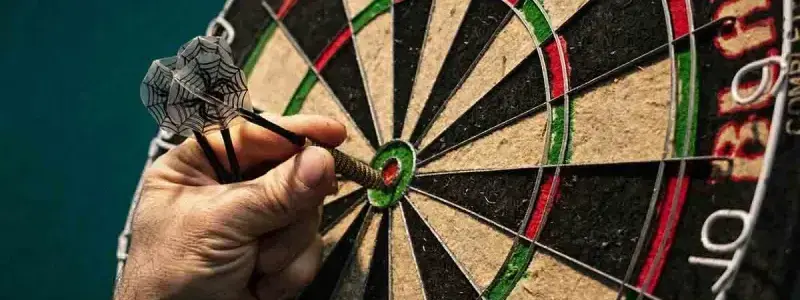
Forget the standard 20-segment dartboard. A vogelpik board is distinctly smaller, made of wood or cork, and divided into small scoring areas with assigned point values.
Many boards center on a small bull that classic play revolves around. If you're used to a regulation board, the tiny target zone is a genuine shock — a bigger change than any of the usual dartboard differences.
The darts match the board's old-world character. They're fletched with actual bird feathers instead of plastic flights, which changes how they fly and adds to the charm.
How to Play: The Classic Café Game
In the traditional version, players simply throw for the highest score. The small bull is the prize target, and every turn is a straight contest of precision.
It plays a lot like a count-up game on a standard board — if you know Count-Up darts, you already understand the rhythm. Highest total wins the round, and bragging rights carry to the next one.

- Regulation compressed sisal surface heals around steel tips for a long playing life
- Rotating number ring spreads out wear to extend the board's lifespan
- Includes six steel tip darts so you can start playing right out of the box
The 101 Countdown Variant
The most popular competitive variant runs as a countdown. Each player starts on 101 points and throws three darts per turn, subtracting everything they score.
The catch: you have to reach exactly zero, no more and no less. Overshooting doesn't win, so the endgame becomes a careful arithmetic puzzle rather than a race.
Say you're sitting on 9 after two turns. You now need combinations that land precisely on zero, and a careless big score just strands you there.
Since vogelpik is a café game, houses settle the fine print — like what happens after an overshoot — their own way. Agree on it before the first dart, the same habit that serves you in 301 darts and other countdown games.
Why It Works for Any Group
Vogelpik demands sharp focus, hand-eye coordination, and a bit of strategic thinking, but the basic idea takes a minute to learn. That makes it a natural fit for family gatherings and social evenings where skill levels are all over the map.
Each game tests precision and patience without ever feeling heavy. Friendly needling across the table is part of the tradition.
If you're ever in Belgium, look for a local competition. Watching regulars thread feathered darts into a cork board is the fastest way to pick up the finer points.
Find a vogelpik board — or any small target and a steady hand — and play a 101 countdown tonight.