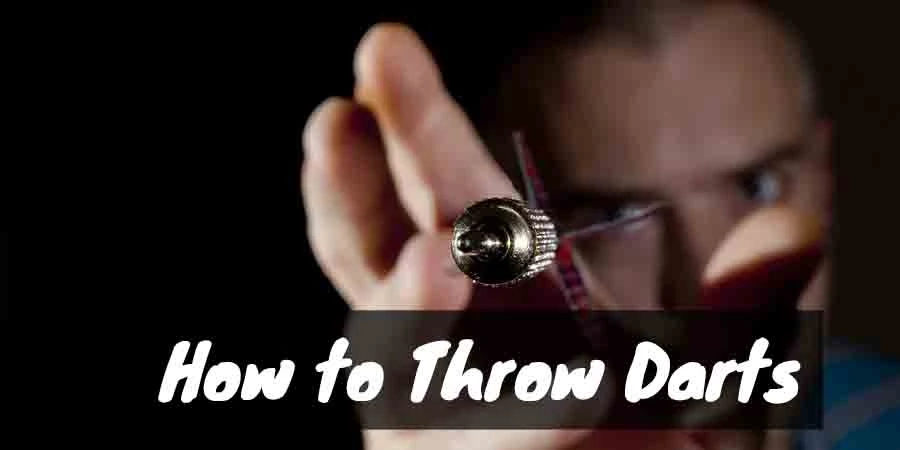
Throw Darts Accurately: The Boring Secret
Your elbow drifts sideways mid-throw, your grip clamps down at the last instant, and the dart you aimed at treble 20 thuds into the 1. The frustrating part is that the shot was doomed before the dart ever left your hand.
Accuracy in darts isn't a gift — it's a chain of small mechanics you can fix one link at a time. Here's how to tighten up your stance, grip, aim, and release so more darts land where you're actually looking.
Start With Your Stance
Precision begins at your feet, because a wobbly base makes every throw a guess. Stand with your dominant foot forward and your feet about hip-width apart.
Turn your body side-on so it's roughly perpendicular to the board. That alignment points your throwing arm at the target naturally, without you fighting your own shoulders.
Put most of your weight on that front foot. It steadies you and adds a little effortless power to the throw.
Don't stack everything on one leg, though. If you're leaning so hard that you sway, your dart drifts with you.
Should You Lean or Step?
Some players lean over the oche to shave off distance, while others stay upright to protect their balance. Leaning can work, but it forces you to manage posture and aim at the same time.
If you lean, keep the angle modest and identical on every throw. A deep lean also wears you down fast in a long session, and tired legs mean sloppy darts.
If you like a small forward step, stand a couple of feet behind the line so your foot never crosses it. Cross the line and your throw doesn't count — in league play it can get you penalized.
Grip the Dart Properly
Before you worry about finger placement, find the dart's center of gravity. Balance it across one finger, and the spot where it sits level is where you should grip.
Hold it with three or four fingers, not two — a two-finger pinch leaves the dart unstable. Place two or three fingers on one side with your thumb opposite, right at that balance point.
Keep in mind that different darts balance differently depending on their barrel shape. Re-find the balance point whenever you switch sets.
Grip pressure matters as much as finger count. Hold the dart like a potato chip — firm enough that it won't slip, gentle enough that nothing crunches.
Keep your unused fingers open and relaxed instead of curled into your palm. Clenched fingers add tension, and tense hands twitch at release.
For a deeper dive into finger placement and pressure, see this guide to gripping a dart.

- Front-weighted barrels support a comfortable and controlled three-point grip
- Deep grooves and triple-milled surfaces provide a secure grip for more consistent throws
- The included storage box keeps up to 12 darts and spare parts organized and protected
Sharpen Your Aim
There's no universal aiming trick — your eyes, your dominant hand, and your habits are yours alone. What every accurate player shares is a consistent line of sight.
Line up your eye, the dart, and the target so all three sit on one line before every throw. Most players sight along the dart's tip with their dominant eye.
Then treat your misses as data, not bad luck. If you keep drifting three inches left, you don't need more effort — you need to shift your aim three inches right.
Throw With a Quiet Body and a Loose Arm
During the throw, only your throwing arm should move. Your legs, torso, and head stay still, because any extra motion gets transferred straight into the dart.
Think of your arm as a lever hinged at the elbow. The upper arm stays fixed and roughly parallel to the floor while the forearm swings forward like a whip.
Stay loose through the whole motion. A stiff, forced throw pushes the dart off line more often than a relaxed one ever will.
Release the dart on an arc, not a laser line. Darts always fly in a slight curve, and pretending otherwise sends your shots low.
How much arc you need depends on the dart's build and what weight darts you use — heavier darts fly flatter, lighter ones loop more. Practice with the same darts you compete with so you learn their exact flight.
Finish with a full follow-through, letting your fingers point at the target after release. Cutting the motion short is one of the most common accuracy killers.
How to Throw Darts Like a Pro (Video)
Build Accuracy Through Practice
Mechanics only stick when you repeat them. Short, focused sessions beat marathon ones — 20 minutes of deliberate throwing at a single number does more than two aimless hours.
Pick one target per session, like treble 20 or the bull, and track how many of nine darts land in it. When the number climbs week over week, your mechanics are working.
Grab your darts, pick one number, and don't leave the oche until you've hit it nine times.