
Fives: The Game Where Most Throws Score Zero
Nineteen, a fat single 2, and a stray 1 — your three darts total 22, and the scorer just shakes his head. In Fives, a turn that won't divide by five is worth exactly nothing.
That one rule turns a simple throwing game into a running math puzzle. Here's how Fives works, how the scoring shakes out, and how to keep your turns from vanishing into zeros.
What Is Fives?
Fives is a lesser-known pub game that lives in the shadow of 501 and Cricket but plays like neither. The name comes from its core rule: every score you bank must be divisible by five.
Accuracy still matters, but your mental arithmetic has to be just as sharp. Each dart changes the math for the next one.
Where It Comes From
Fives is believed to have started in East London, though its precise origins were never documented. Like most traditional dart games, it grew out of British pub play, where regulars kept inventing variations to stay entertained.
The divisible-by-five rule was the twist that stuck. That extra layer of complexity is exactly why the game has endured.
Rules and Scoring
Each player throws three darts per turn on a standard board. Add up the three darts: if the total divides evenly by five, you score that total divided by five.
If it doesn't divide evenly, you score nothing for the round. There's no rounding — a total of 22 yields zero points.
Play continues in turns for a predetermined number of rounds. Highest score at the end wins.
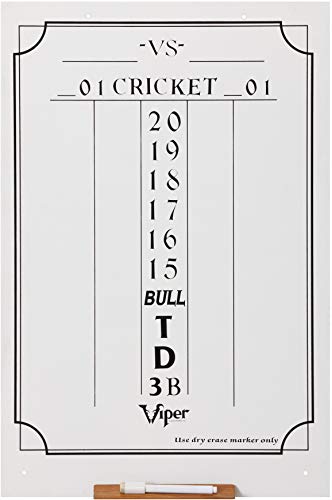
- Purpose-made layout tracks Cricket and 01 games at a glance
- Smooth surface works with any dry erase marker, and one comes included
- Mounting hardware is included for easy setup on a wall or cabinet door
A Worked Example Turn
You land single 20, single 20, and single 5 for a total of 45. That divides by five, so you bank 9 points.
Your opponent hits 19, 2, and 1 for 22. Not divisible by five, so their round scores zero — and that's the whole brutal charm of Fives.
Strategy: Protecting the Math
Aim at the 5 and the 20. Both sections keep your running total on a multiple of five, so they're the steadiest sources of points in the game.
Train your mental math until it's automatic. Knowing instantly what your third dart needs is the difference between a scoring round and a zero — our dartboard math guide is good gym work for it.
Know when to play safe. If your first two darts total 10 or 15, a guaranteed five-spot often beats gambling on a risky high-value area and busting the whole turn.
Equipment for Fives
Any standard 1-to-20 dartboard works — the same board you'd use for 501 or Cricket. Hang it properly, 5 feet 8 inches from the floor to the bullseye, in a well-lit spot; our guide on how to hang a dartboard covers the details.
Darts run from 12 to 50 grams, with most players settling between 20 and 30. If you're unsure, start with our advice on what weight darts to use.
Brass darts are budget-friendly but wear faster, while tungsten lasts longer and stays slim for tighter grouping. Shaft length is personal: longer shafts add stability but can be harder to control.
One more essential: a scoreboard. With totals being divided every round, a chalkboard, whiteboard, or scoring app keeps the game honest.
5 Dart Games for Beginners (Video)
Next time you're at the board, play a few rounds of Fives — and count before you throw that third dart.